
Peter Atkins - Old Geelong Road
Old Geelong Road was the second of a series of level crossing removal art commissions led by T Projects. We developed the brief, sourced artists, assisted the shortlisted artists throughout concept design, before supporting the selected artist, Peter Atkins, through detailed design to completion.

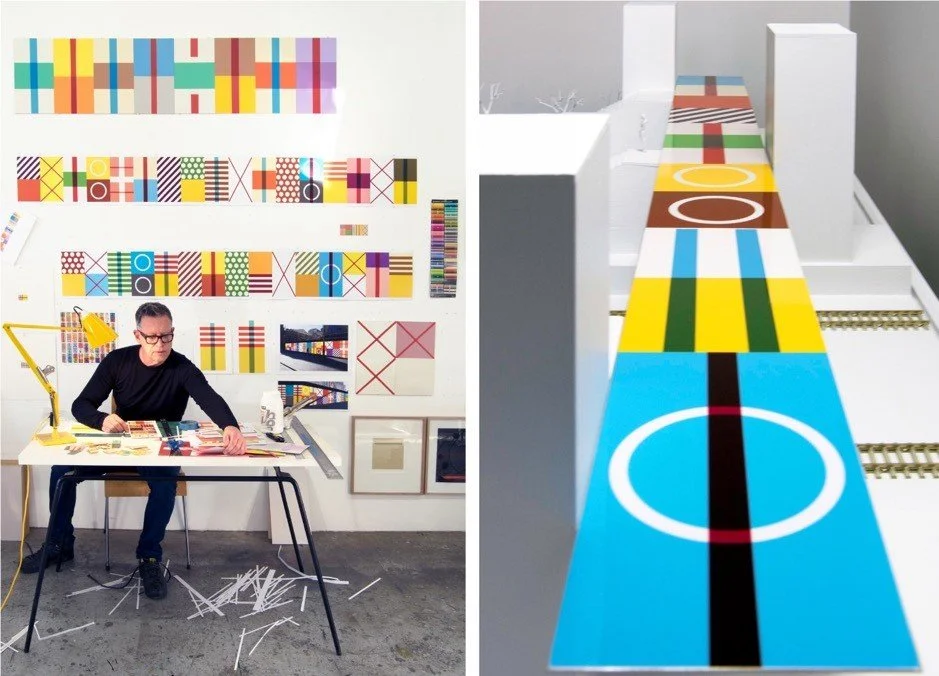
Peter's practice centres around the deconstruction of ready-made abstract forms that he documents within the urban environment. "TRACKwork" explores our collective social, cultural and personal narratives, taking visual inspiration from original suburban train tickets issued between 1920 and the late 1980s.
'All those circles and stripes meant something. It's like the stripe was a return ticket, the circle was to certain stations. Your colours represented particular stations…the brown might've been a one-way ticket, and then the yellow part was the return ticket.'
For Peter, the train tickets remain the ultimate social connector.
'When you a buy a train ticket, we're all the same. There's this lovely kind of democracy… they belong to everyone.'
The artwork took approximately three weeks to install, with crews laying approximately 11,000 tiles in ten vibrant different colours.

Client
Level Crossing Removal Project
Artist
Project Team
Western Program Alliance with Denton Corker Marshall, Hassell, Arup, McConnell Dowell & Mott Macdonald
Fabricator
Photography
Courtesy of the artist
PETER ATKINS
Peter Atkins is a leading Australian contemporary artist and an important representative of Australian art in the International arena. Over the past thirty-five years he has exhibited in Australia, New Zealand, England, France, Spain, Italy, Japan, Korea, Taiwan and Mexico. He has been described as 'a cultural nomad' by the former director of the Art Gallery of South Australia, Daniel Thomas, 'an obsessive psychological wanderer' by curator Simeon Kronenberg, 'a visual anthropologist' by the director of Fleisher/Ollman Gallery in Philadelphia, Alex Baker, 'a visual terrorist' by Spanish Curator and arts writer Paco Barragan and 'a hyper-caffeinated bowerbird' by arts writer Ashley Crawford.
Atkins’ practice centers around the appropriation and re-interpretation of readymade abstract forms that he documents within the urban environment. This collected material becomes the direct reference source for his work, providing tangible evidence to the viewer of his relationship and experience within the landscape. Particular interest is paid to the cultural associations of forms that have the capacity to trigger within the viewer, memory, nostalgia or a shared history of past experiences. Recent projects including Disney Color Project, Hume Highway Project, Station to Station, Polaroid Project and The Passengers all evoke within the viewer our collective, cultural recall. Over the past decade he has used the term ‘abstraction from the real world’ as a way to describe his practice. Peter states that 'it's a term that defines the space between non-objective abstraction and representation. Peter states that ‘My work could be described as an amalgamation of Modernisms attention to process and materials, Pop Arts re-contextualization of mundane mass cultural objects, Minimalisms desire to achieve simplicity through the elimination of all non-essential features and Post Modernisms re-examination, appropriation and deconstruction of all that has gone before. These amorphous boundaries are a calculated attempt to blur the distinction between High Art, Low Art and popular culture.’